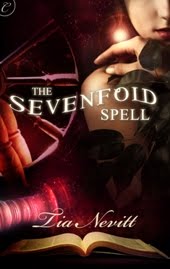
The good news is The Sevenfold Spell is out today! Woo Hoo! Here are some buy links!
ePub and PDF Format
Kindle Format
Help a new author! Spread the word!
The bad news--I'm really having a hard time with Chinese spammers, so I'm going to have to add a captcha or something to my comment system. I hate captchas. But I'm going to have to do it because I hate spam on my comments. I'll see what options I have before I go the captcha route.
I did come this close >< to shutting down this blog altogether, bit I like keeping a more personal and cozy blog, so I'll see what I can do. Really, Google needs to get ON IT with the spam. Wordpress does a much better job!
Monday, September 27, 2010

Sunday, August 8, 2010
The Print-Out Phase
Yesterday, I reached the point in my Cinderella retelling where I print it out and go over it with a red pen. I am just a more effective editor on paper, and I print out all stories/novellas/novels at least twice during the editing process. You may think that this is a waste of paper, but there is NOTHING like seeing your work printed out. After all, the finished product will appear on paper (or e-ink, which is in many ways better than paper, for reading purposes). If you are not doing this, go ahead and try. I think you will be astonished at all the errors that sneak in. For this reason, I'd hate to ever see my blog printed.
The first time I print it is when I'm still trying to organize the story. This story is still a dreadful mess, and I just need to draw arrows all over it and generally have the freedom of a pen. I print it out a second time when I THINK I am done. Once again I use my red pen on it--hopefully making way fewer marks--and I read it aloud. Hearing the story also helps me hone the voice. Especially when trying to polish the rhythm of dialog.
I still have not finished the ending. My first stab will go in the garbage--I don't like it. I'm trying to refine a second ending, but I need to think of a devious plan for one of my antagonists, and I'm just having a hard time thinking of one. I'm hoping the exercise of reading it aloud will help spur a few ideas.
At this point, Before my sale, I would have set the whole story aside. But I've made an oral commitment to produce another fairy tale retelling, and I think they expect it within a year. And I'm finding that setting the entire story aside isn't really required. Instead, I can simply skip a scene and write the scene that I really want to write. And if I need something fresh, why what works better than a new plot twist? Both of these techniques spur on those scenes in the middle, which will hopefully result in a finished story.
The first time I print it is when I'm still trying to organize the story. This story is still a dreadful mess, and I just need to draw arrows all over it and generally have the freedom of a pen. I print it out a second time when I THINK I am done. Once again I use my red pen on it--hopefully making way fewer marks--and I read it aloud. Hearing the story also helps me hone the voice. Especially when trying to polish the rhythm of dialog.
I still have not finished the ending. My first stab will go in the garbage--I don't like it. I'm trying to refine a second ending, but I need to think of a devious plan for one of my antagonists, and I'm just having a hard time thinking of one. I'm hoping the exercise of reading it aloud will help spur a few ideas.
At this point, Before my sale, I would have set the whole story aside. But I've made an oral commitment to produce another fairy tale retelling, and I think they expect it within a year. And I'm finding that setting the entire story aside isn't really required. Instead, I can simply skip a scene and write the scene that I really want to write. And if I need something fresh, why what works better than a new plot twist? Both of these techniques spur on those scenes in the middle, which will hopefully result in a finished story.
Sunday, July 25, 2010
Reasonably Productive Week
I got another 3000 words done this week, and I'm over three-quarters of the way through my Cinderella retelling. The layer I'm adding to the story now is the romance subplot. I'm no longer thinking that this story sucks quite so much. Things are coming together.
In order to give it a little soul, I decided to put a tragic event in Yvette's past--a shameful event that results in a secret that she must bury. And of course, that secret will come to light to the very person she most wants to keep it from. I'm also being coy about revealing the secret to the reader. The reader will find out exactly what it is only when the hero finds out from the worst possible source. And the reader won't hear the whole story until Yvette must tell it to him.
Abrupt subject change--I found it necessary to research the history of football for this story. Yes, the oddest things come out while storytelling--who would ever have guessed that football belongs in a fairy tale retelling? But Pierre--my love interest--was once at the same school as the prince, and they played on the same football team.
I researched football just enough to learn that I was indeed safe in calling it football. And then I stopped researching it. I call this little technique "just-enough researching". It's kind of like my "just-enough worldbuilding" technique. Don't get me wrong--I love to research. But I don't like bogging the story down in unnecessary detail. Who cares if the football back then was like modern-day soccer or modern-day rugby or modern day football? I certainly don't. All I really care about is that football is the appropriate term to use.
In other news, my short story, "Once Upon a Gas Tank" is now overdue from the last market I sent it to. I don't know if this is a positive thing or not. I used to think that if they had a story for a long time, then it means they are seriously considering it. But The Sevenfold Spell sold in three weeks, and another market had another story for over three months before rejecting it. So the only thing I really know for certain now is they haven't reject it yet.
Don'tya love this writing game?
In order to give it a little soul, I decided to put a tragic event in Yvette's past--a shameful event that results in a secret that she must bury. And of course, that secret will come to light to the very person she most wants to keep it from. I'm also being coy about revealing the secret to the reader. The reader will find out exactly what it is only when the hero finds out from the worst possible source. And the reader won't hear the whole story until Yvette must tell it to him.
Abrupt subject change--I found it necessary to research the history of football for this story. Yes, the oddest things come out while storytelling--who would ever have guessed that football belongs in a fairy tale retelling? But Pierre--my love interest--was once at the same school as the prince, and they played on the same football team.
I researched football just enough to learn that I was indeed safe in calling it football. And then I stopped researching it. I call this little technique "just-enough researching". It's kind of like my "just-enough worldbuilding" technique. Don't get me wrong--I love to research. But I don't like bogging the story down in unnecessary detail. Who cares if the football back then was like modern-day soccer or modern-day rugby or modern day football? I certainly don't. All I really care about is that football is the appropriate term to use.
In other news, my short story, "Once Upon a Gas Tank" is now overdue from the last market I sent it to. I don't know if this is a positive thing or not. I used to think that if they had a story for a long time, then it means they are seriously considering it. But The Sevenfold Spell sold in three weeks, and another market had another story for over three months before rejecting it. So the only thing I really know for certain now is they haven't reject it yet.
Don'tya love this writing game?
Monday, July 19, 2010
Writing in Layers
After finishing an extremely rough draft for my Cinderella retelling, I realized that I write in layers.
The first layer is the biggest layer. It's the main plot. Each additional layer is a subplot. And I've discovered that I cannot really think too much about the subplots until I've nailed the plot.
And, I don't ever seem to come up with an ending the first time around. So this time, I did what I did in Starcaster on purpose, and in The Sevenfold Spell by accident. I left the ending unfinished. (With The Sevenfold Spell, I thought I had an ending, but I discovered I did not.)
But more on layers. As I was writing, I knew there would be an uneven romance between commoner Yvette and nobleman Pierre. But I didn't know exactly how it would work out. I also knew that Pierre's sister would be a problem for Yvette, and I knew how she would be in the overarching plot (she's after revenge), but I didn't know how I was going to make it personal for Yvette. I'm a bit closer now--and it will involve Pierre.
I also have this whole jealousy subplot with the stepsisters, and I realized that overcoming jealousy would be the whole theme behind the novella.
So there's four layers - the main plot, the romantic subplot, the revenge subplot, the stepsister subplot. Each plot/subplot equals one major character, so we have Yvette, Pierre, Esmerele and Agnes.
Since the main plot--the extremely sketchy main plot--worked out to 13,000 words, I think that will fill up a 20,000 word novella quite nicely.
In other news, my proposed series title for my fairy tale retellings is now official! The series will be called Accidental Enchantments. I'm thrilled!
The first layer is the biggest layer. It's the main plot. Each additional layer is a subplot. And I've discovered that I cannot really think too much about the subplots until I've nailed the plot.
And, I don't ever seem to come up with an ending the first time around. So this time, I did what I did in Starcaster on purpose, and in The Sevenfold Spell by accident. I left the ending unfinished. (With The Sevenfold Spell, I thought I had an ending, but I discovered I did not.)
But more on layers. As I was writing, I knew there would be an uneven romance between commoner Yvette and nobleman Pierre. But I didn't know exactly how it would work out. I also knew that Pierre's sister would be a problem for Yvette, and I knew how she would be in the overarching plot (she's after revenge), but I didn't know how I was going to make it personal for Yvette. I'm a bit closer now--and it will involve Pierre.
I also have this whole jealousy subplot with the stepsisters, and I realized that overcoming jealousy would be the whole theme behind the novella.
So there's four layers - the main plot, the romantic subplot, the revenge subplot, the stepsister subplot. Each plot/subplot equals one major character, so we have Yvette, Pierre, Esmerele and Agnes.
Since the main plot--the extremely sketchy main plot--worked out to 13,000 words, I think that will fill up a 20,000 word novella quite nicely.
In other news, my proposed series title for my fairy tale retellings is now official! The series will be called Accidental Enchantments. I'm thrilled!
Friday, July 16, 2010
A Literary Meme
Susanna Fraser, author of the intriguing upcoming Carina Press title, The Sergeant's Lady, inspired me to do a meme!
1) What author do you own the most books by?
John Steinbeck, I think. Either him or Charles Dickens or Mark Twain.
2) What book do you own the most copies of?
The Bible. We seem to have been collecting them over the years, and we have multiple translations.
3) Did it bother you that both those questions ended with prepositions?
Didn't notice.
4) What fictional character are you secretly in love with?
It's no secret--Fitzwilliam Darcy. Henry Crawford had a lot of potential too. And of course, Henry Tilney. Sigh!
5) What book have you read the most times in your life (excluding picture books read to children; i.e., Goodnight Moon does not count)? The Once and Future King
6) What was your favorite book when you were ten years old? Sadly, I didn't become a reader until the next year. It was all still too new to me for me to have a favorite. But I loved Nancy Drew's The Hidden Staircase by the time I was twelve.
7) What is the worst book you’ve read in the past year?
I stop reading if I'm not enjoying it.
9) If you could force everyone you tagged to read one book, what would it be?
I'll skip this question.
10) Who deserves to win the next Nobel Prize for Literature? Dunno.
11) What book would you most like to see made into a movie?
The Manual of Detection by Jedediah Berry.
12) What book would you least like to see made into a movie?
??
13) Describe your weirdest dream involving a writer, book, or literary character.
I have a dreadful time recalling my dreams beyond ten minutes after I wake up.
14) What is the most lowbrow book you’ve read as an adult?
The X-Men. But, I do have comic-book versions of Pride and Prejudice and Der Ring Des Nibelungen. Seriously!
15) What is the most difficult book you’ve ever read?
Crime and Punishment.
16) What is the most obscure Shakespeare play you’ve seen?
Um. Next question.
17) Do you prefer the French or the Russians?
The French. That being said, of the two nationalities, I've only read Dostoevsky, Hugo and Dumas.
18) Roth or Updike? Um . . .
19) David Sedaris or Dave Eggers? Um . . .
20) Shakespeare, Milton, or Chaucer? Chaucer.
21) Austen or Eliot? Austen. But I loved George Eliot's Silas Marner!
22) What is the biggest or most embarrassing gap in your reading?
I really have not read enough Shakespeare.
23) What is your favorite novel?
Not an answerable question.
24) Play?
Pygmalion. I can only name a favorite because I've seen so few.
25) Poem?
Um . . .
26) Essay?
Why?
27) Short story?
See question on novels.
28) Work of nonfiction?
Ditto.
29) Who is your favorite writer?
Mark Twain and Jane Austen.
30) Who is the most overrated writer alive today?
No opinion.
31) What is your desert island book?
I'd probably try to finish reading the Bible. Yes, we have a lot of them, but I still have not read it from cover to cover. Bad, I know . . .
32) And … what are you reading right now?
Bewitched and Betrayed by Lisa Shearin, Scene Stealer by Elise Warner, Meeks by Julia Holmes, Anne of Green Gables by Lucy Maud Montgomery.
If you decide to take part, be sure to let me know!
1) What author do you own the most books by?
John Steinbeck, I think. Either him or Charles Dickens or Mark Twain.
2) What book do you own the most copies of?
The Bible. We seem to have been collecting them over the years, and we have multiple translations.
3) Did it bother you that both those questions ended with prepositions?
Didn't notice.
4) What fictional character are you secretly in love with?
It's no secret--Fitzwilliam Darcy. Henry Crawford had a lot of potential too. And of course, Henry Tilney. Sigh!
5) What book have you read the most times in your life (excluding picture books read to children; i.e., Goodnight Moon does not count)? The Once and Future King
6) What was your favorite book when you were ten years old? Sadly, I didn't become a reader until the next year. It was all still too new to me for me to have a favorite. But I loved Nancy Drew's The Hidden Staircase by the time I was twelve.
7) What is the worst book you’ve read in the past year?
I stop reading if I'm not enjoying it.
9) If you could force everyone you tagged to read one book, what would it be?
I'll skip this question.
10) Who deserves to win the next Nobel Prize for Literature? Dunno.
11) What book would you most like to see made into a movie?
The Manual of Detection by Jedediah Berry.
12) What book would you least like to see made into a movie?
??
13) Describe your weirdest dream involving a writer, book, or literary character.
I have a dreadful time recalling my dreams beyond ten minutes after I wake up.
14) What is the most lowbrow book you’ve read as an adult?
The X-Men. But, I do have comic-book versions of Pride and Prejudice and Der Ring Des Nibelungen. Seriously!
15) What is the most difficult book you’ve ever read?
Crime and Punishment.
16) What is the most obscure Shakespeare play you’ve seen?
Um. Next question.
17) Do you prefer the French or the Russians?
The French. That being said, of the two nationalities, I've only read Dostoevsky, Hugo and Dumas.
18) Roth or Updike? Um . . .
19) David Sedaris or Dave Eggers? Um . . .
20) Shakespeare, Milton, or Chaucer? Chaucer.
21) Austen or Eliot? Austen. But I loved George Eliot's Silas Marner!
22) What is the biggest or most embarrassing gap in your reading?
I really have not read enough Shakespeare.
23) What is your favorite novel?
Not an answerable question.
24) Play?
Pygmalion. I can only name a favorite because I've seen so few.
25) Poem?
Um . . .
26) Essay?
Why?
27) Short story?
See question on novels.
28) Work of nonfiction?
Ditto.
29) Who is your favorite writer?
Mark Twain and Jane Austen.
30) Who is the most overrated writer alive today?
No opinion.
31) What is your desert island book?
I'd probably try to finish reading the Bible. Yes, we have a lot of them, but I still have not read it from cover to cover. Bad, I know . . .
32) And … what are you reading right now?
Bewitched and Betrayed by Lisa Shearin, Scene Stealer by Elise Warner, Meeks by Julia Holmes, Anne of Green Gables by Lucy Maud Montgomery.
If you decide to take part, be sure to let me know!
Sunday, July 11, 2010
Excerpt from Cinderella Retelling
Sorry about the blog silence! To make up for it, here is an excerpt from my Cinderella retelling, which is unnamed for now. This is my opening scene. I wrote this because I needed to get behind Pierre's eyeballs so I could fall in love with him a little:
(Interruption - Blogger dropped my post when I finished it this morning! I was so traumatized that I was not able to come back and rewrite this until now. Anyway, here it is:)
I trust everyone knows what a codpiece is? If not, you'll know by the next scene, if you read it. I coined a French word here, valette, and I trust I did it right, but I'll have to run it by an actual French speaker to be sure. The Sevenfold Spell had a British flavor, so I'm making this one French. I'm thinking the Snow White retelling might be German, and Beauty and the Beast will be Irish. If I write any retellings beyond those, I'll go for other cultures. India especially has some wonderful legends.
What are your favorite legends or fairy tales?
(Interruption - Blogger dropped my post when I finished it this morning! I was so traumatized that I was not able to come back and rewrite this until now. Anyway, here it is:)
“A woman, monsieur?”
Pierre ignored his valet’s doubtful tone. “Not just any woman, Corbeau. The modiste’s daughter.”
“And she’s a valet?”
“Of course not. She’s a . . . a . . . well, I don’t think society has a name for what she does. But her mother has created my suit for the festivities, and her daughter . . . well, she’s going to do me.”
“Do you, monsieur?”
“No, do me. That’s how she puts it. She does people.”
“If you don’t mind my saying so, monsieur—but you can hardly bear to be done by me. Why the sudden interest in being done, as this . . . this mysterious valette insists upon putting it?”
Pierre grinned, knowing Corbeau wasn’t nearly as annoyed as he sounded. “For that, you could only understand if you knew the valette herself.”
“Aah. Well in that case, I have a word of advice, monsieur.”
“Yes, Corbeau?”
“Wear a codpiece.”
I trust everyone knows what a codpiece is? If not, you'll know by the next scene, if you read it. I coined a French word here, valette, and I trust I did it right, but I'll have to run it by an actual French speaker to be sure. The Sevenfold Spell had a British flavor, so I'm making this one French. I'm thinking the Snow White retelling might be German, and Beauty and the Beast will be Irish. If I write any retellings beyond those, I'll go for other cultures. India especially has some wonderful legends.
What are your favorite legends or fairy tales?
Sunday, June 27, 2010
One-Fourth Done!
I went past 5000 words today, which means I'm still behind, but I got caught up by quite a bit. My deadline is toward the end of July, so I might still be good.
With Fairy Godmothered--and I'm beginning to think a title change might be in order--I'm trying to keep on target even when I have some writer's block. Yesterday morning I woke up with some great ideas and banged out several thousand words before everyone else got up. I'm still getting to know my characters and until I get to that point, things can be a little rocky.
I'm often inspired by movies, and in this case, the inspiration is Dangerous Liaisons from 1988. Fairy Godmothered is not going to be anywhere near that risque--in fact, next to The Sevenfold Spell it's going to be squeaky-clean--but I'm giving the novella a French setting and I have some dressing scenes for which I needed to consult the opening scenes of Dangerous Liaisons. Every time I watch that movie, I think, no wonder there was a French revolution.
My favorite characters so far? The jealous stepsisters. I got one who is genuinely bad, but the other just has a character weakness with jealousy. Ought to be fun.
With Fairy Godmothered--and I'm beginning to think a title change might be in order--I'm trying to keep on target even when I have some writer's block. Yesterday morning I woke up with some great ideas and banged out several thousand words before everyone else got up. I'm still getting to know my characters and until I get to that point, things can be a little rocky.
I'm often inspired by movies, and in this case, the inspiration is Dangerous Liaisons from 1988. Fairy Godmothered is not going to be anywhere near that risque--in fact, next to The Sevenfold Spell it's going to be squeaky-clean--but I'm giving the novella a French setting and I have some dressing scenes for which I needed to consult the opening scenes of Dangerous Liaisons. Every time I watch that movie, I think, no wonder there was a French revolution.
My favorite characters so far? The jealous stepsisters. I got one who is genuinely bad, but the other just has a character weakness with jealousy. Ought to be fun.
Subscribe to:
Posts (Atom)